Approach to Human Resource Management
We believe that it is our corporate social responsibility to respect the ideas and actions of autonomy and
independence of each individual employee who is entrusted to us by society, and to provide them with opportunities to
develop through their work. To this end, we respect the character, individuality, and diversity of our employees and,
by ensuring a safe and comfortable working environment, we will fulfill our responsibilities at work, at home, and in
society. We will promote the creation of a vibrant and rewarding workplace where both employees and the company can
develop together.
Basic employee data (Scope: Japan, as of the end of the fiscal year)
Personnel Evaluation and Compensation System
In FY2017, we introduced a new annual salary-based personnel evaluation and compensation system for managers that
emphasizes the following four points: Correcting seniority-based treatment; reflecting contribution to the company in
compensation; a compensation system based on company, department, and individual performance; and motivation to take
on challenges. In addition, a new personnel evaluation and compensation system for general employees in April 2019 was
introduced, which focuses on early promotion to management positions, raising wages for young to mid-career employees,
promotion and salary increases based on evaluations, and correction of seniority-based treatment. Through these system
reforms, we will work together to encourage employees to take on new challenges, and to create a rewarding workplace
where the company can develop, and employees can have dreams and take pride in their work. In fiscal 2017, we
introduced an annual salary-based personnel evaluation and compensation system for managers that emphasizes the
following four points: correction of seniority-based treatment; reflection of the degree of company contribution in
compensation; a compensation system based on company, division, and individual performance; and stimulation of the
desire to take on challenges.
Overview of the personnel evaluation and compensation system
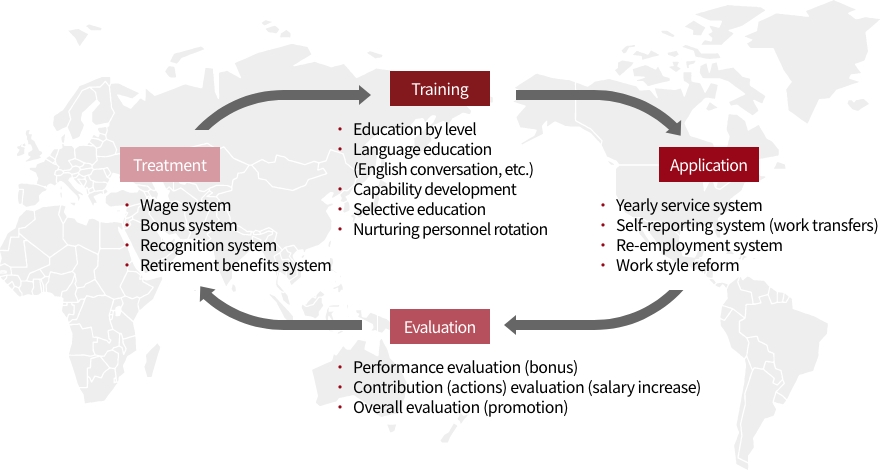
Introduced a new evaluation system for managers
A new evaluation system for managers was introduced in FY2022.
A new evaluation system for managers will be introduced in FY2022.
Ensuring that the process of the new evaluation system is implemented will likely lead to motivation, acceptance, and
effective training for the evaluation. The following process will be used to implement the new evaluation system.
Goal-setting session
In order to ensure a sense of fairness throughout the company, we have started the year by having evaluators discuss the validity and difficulty of the subject‘s goals across departments, and have a sense of level and recognition of the goal setting. Regarding the goals set in this way, we would like to ensure transparency and minimize the sweetness of evaluations between departments to ensure fairness by evaluating the status of achieving the goals at the time of evaluation decision at the end of the fiscal year.
Quarterly feedback
Every quarter, supervisors and subordinates mutually confirm the process, issues, expectations, and degree of achievement toward goals to make early awareness and course corrections, and we hope to increase the sense of satisfaction of the assessee by preventing surprises from occurring in the results of year-end appraisals.
★By changing to an evaluation system that utilizes the above process (goal setting feedback), we will lead to an
improvement in motivation and a sense of satisfaction of the Assessed.
Conducting a meeting to determine year-end performance evaluation results
Through the process of evaluating human assets strictly from two perspectives, performance and value (contribution),
the evaluators' perspectives on human assets (goal setting, evaluation, and contribution) are aligned with each other,
thereby minimizing the possibility of errors between the evaluators.
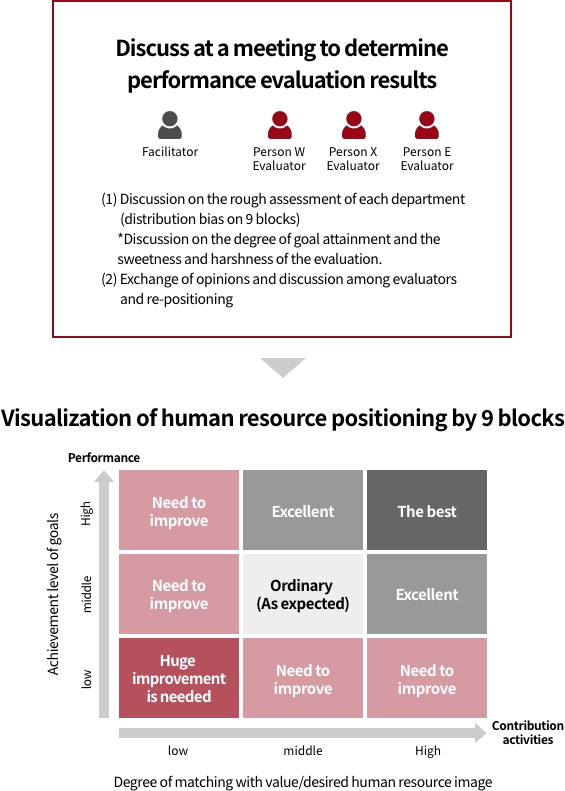
★The above process (evaluation result determination meeting) will map human resources in relative terms to grasp
individual characteristics (strengths and weaknesses) and link them to the placement of the right personnel in the
right positions and human resource development plans.
To Enhance Employee Satisfaction
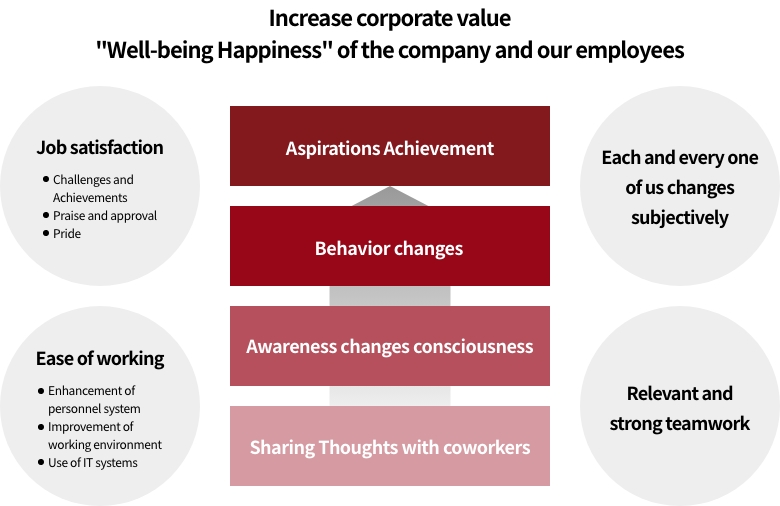
In order to think of "work style reform" as "lifestyle reform" and make "the way of life of the company" and "the way
of life of employees" more valuable, we will start full-scale work style reform activities from fiscal 2020, and each
department will start self-propelled from fiscal 2023.We aim to ensure that each and every employee who works at our
company enjoys their daily lives while feeling rewarded, which leads to high results as a company, and enhances both
the value of the company and the happiness of employees
The keyword for improving employee’s job satisfaction is "sharing thoughts and feelings"
We are a manufacturing company, but we believe that the source of everything we do is "people".
Each and Each of our employees has a dream of "I want to become like this!" and "I want to achieve this!“.
We will create Well-being Happiness together by mutually sharing each other's thoughts and feelings.
Example of initiatives
- (1)Survey on employee job satisfaction: Conducted annually.
- (2)Team activities to improve job satisfaction in each department: Based on the
results of (1),we will carry out PDCA activities for improvement on a daily basis.
- (3)
- Improving the quality of management and making it more rewarding...We have started implementing tools to improve organizational outcomes, and we plan to conduct diversity training for both managers and selected employees.
- (4)
- Revision of the personnel system We are revising our personnel system so that employees will choose a career track upon promotion to a certain grade, supporting the realization of their career plans.
- (5)Supporting employee self-actualization: Introducing internal recruitment and FA
system to support career development for employees' self-actualization.
- (6)Improvement of working environment: Activities to improve facilities and
equipment at factory sites and indirect offices are being implemented by employees.